Thanks to Suzanne K. in Port Jervis, New York, for sharing her cleaning experience with…


Norwex Troubleshooting & FAQs: Answers to Your Most Common Norwex Problems
Is your Norwex cloth starting to smell?
Did your Window Cloth suddenly start leaving streaks?
Are your microfiber cloths feeling stiff, repelling water or just not cleaning like they used to?
Is your Norwex Mop leaving streaks or a film on your floor?
Or maybe you bought a product, used it once and thought…
“Ummm, Sonya? Am I doing this wrong?” ?
You’re in the right place.
I’ve been using Norwex products in my own home and teaching other people how to use them for more than 17 years. And one thing I’ve learned is that when someone tells me a Norwex product “doesn’t work,” there is very often something we can troubleshoot.
Sometimes it’s how the product is being used. Sometimes it’s how it was washed. Sometimes hard water is the culprit. Sometimes we’re simply using the wrong product for the job.
And sometimes? A product just isn’t the right fit for you. That’s okay too.
My goal with this guide is not to convince you that every Norwex product is perfect. It’s to help you figure out what is happening, what I would try next and whether the product can be saved.

Find Your Norwex Problem Fast
If you’re here because something isn’t working the way you expected, start with the problem you’re experiencing:
- My Norwex cloth smells: Start with Microfiber Troubleshooting
- My cloth is stiff or isn’t absorbing: Start with Microfiber Troubleshooting
- My Window Cloth is leaving streaks: Jump to Window Cloth Troubleshooting
- My Norwex Mop is streaking: Jump to Mop Troubleshooting
- I have hard-water buildup: Jump to Hard-Water Troubleshooting
- My dishes are cloudy or spotted: Jump to Dishwasher + Kitchen Troubleshooting
- I’m worried about scratching something: Jump to Cleaning Paste or Scrubber Troubleshooting
- I don’t understand BacLock® or disinfecting: Jump to BacLock® + Disinfecting FAQs
- I want to know whether I can use Norwex on a particular surface: Jump to Using Norwex on Different Surfaces
Let’s troubleshoot!
Norwex Microfiber Troubleshooting
Let’s start with the questions I probably hear more than anything else.
Why do my Norwex cloths smell?
If your Norwex cloth smells sour, musty or just plain BAD when it gets wet, don’t immediately throw it away.
Typically, I start by looking for some type of buildup in the fibers or a cloth that isn’t getting thoroughly rinsed and dried between uses. Norwex’s current microfiber-care instructions tell users to rinse the cloths between uses (friction the fibers against themselves under running water) and hang it to dry where there is good airflow around it.
As it dries, that amazing microsilver in the BacLock fibers goes to work helping inhibit bacterial odor, mold and mildew growth within the cloth itself.. Often smelly cloths have been left too long wet in a heap or in the washer before being transferred to the dryer. The good airflow to dry is very important. Norwex cloths are made to be machine washed, and dryer dried. Norwex warns against using fabric softener and dryer sheets or bleach, because they can coat or damage the fibers and reduce cleaning performance, as well as reducing the ability of the microsilver to self-purify, since that action happens when the odor-causing bacteria come in contact with the silver in the fibers. Therefore, if the fiber is coated with fabric softener, fillers from detergents, or hard water deposits, that can be the problem.
If your cloth smells, ask yourself:
- Am I thoroughly rinsing my Norwex cloth between uses?
- Am I hanging it where it can completely dry?
- Have I used it for greasy jobs?
- Have I accidentally washed it with fabric softener?
- Did it go through the dryer with a dryer sheet?
- Am I using too much laundry detergent?
- Am I washing it with linty towels?
- Do I have very hard water?
- Has it been a LONG time since I deep cleaned my microfiber?
If you answered yes—or even maybe—to a few of those, I would deep clean it before giving up on it. I have often been able to redeem such situations.
READ NEXT: How to Wash Norwex Cloths + Deep Clean Your Microfiber
Why do my Norwex cloths smell even after washing?
This is the question behind the question.
If you pull the cloth out of the washer and it smells fine, but the sour smell returns the moment you wet it again, that’s a good clue that normal laundering isn’t removing everything trapped in the microfiber.
I would give the cloth a proper deep clean and then look at your regular washing routine so the problem doesn’t immediately return.
Repeatedly washing it the same way that created the buildup usually isn’t going to solve the buildup.
How do I deep clean Norwex cloths?
I have an entire guide devoted to this because the answer deserves more than two sentences.
How to Wash & Deep Clean Norwex Microfiber
One caution here: you’ll find LOTS of homemade Norwex “deep cleaning” recipes online involving vinegar, baking soda, boiling and various combinations of the three. Some of those recommendations have been passed around for years.
I’d rather show you the method I’m currently using and explain the why, rather than have you play chemist with expensive microfiber. ?
Why are my Norwex cloths stiff?
A cloth that once felt soft and flexible but now feels stiff or crunchy may have buildup in the fibers. That can come from detergent residue, grease, minerals in hard water or other laundry products.
Before replacing it, I would:
- Give it a thorough deep clean.
- Make sure you’re not overusing detergent.
- Stop using fabric softener or dryer sheets with your microfiber.
- Wash microfiber with lint-free items.
- Make sure the cloth is being thoroughly rinsed.
- Consider adding white vinegar to your laundry load rinse cycle.
But the top reason I’ve seen “stiff Norwex cloths” is typically hard water (high mineral content) in the home. People with water softeners seem far less prone to experiencing this.
Why isn’t my Norwex cloth absorbing water anymore?
If water seems to sit on top of your microfiber instead of soaking into it, I immediately suspect something coating those tiny fibers. Fabric softener is a major offender. Or hard water mineral deposits on the fiber.
Norwex specifically warns that fabric softeners and dryer sheets can coat the surface of microfiber and reduce its ability to clean effectively.
But detergent residue and other products can create buildup too. My first move would be doing the deep clean. This can often restore absorption of the fibers. From my personal experience, when we lived in Iowa, we did not have a water softener for a period. I can still feel the cloths from that era, as they are more stiff and less absorbent due to the hard-water minerals adhering to the fibers. I can still use them but I need to “squeeze” the water into them. So there may be a point where it’s simply time for a new set of cloths.
I accidentally washed my Norwex with fabric softener. Is it ruined?
Don’t panic. I wouldn’t throw it away because it went through one accidental load. Fabric softener can coat microfiber, so I would thoroughly wash/deep clean the cloth without softener and see whether its absorbency and cleaning performance return.
If you’ve been washing your Norwex with fabric softener for months or years, we may have a bigger challenge—but I’d still try rescuing it before replacing it. It may take a few Deep Clean runs, as fabric softener tends to be very “sticky” to fabrics.
Can I wash Norwex with regular laundry?
Often yes—but do choose your laundry companions carefully.
Norwex recommends laundering microfiber with other lint-free laundry. That matters because you don’t want to start getting small flecks of lint on your mirrors and windows.
I would NOT throw my microfiber into a load of fluffy cotton towels and then wonder why every microscopic fiber seems to have adopted a fuzzy little friend. But washing with athletic wear, bed sheets (not flannel), and blue jeans is typically perfect.
Why is lint stuck all over my Norwex cloth?
Microfiber is designed to pick things up. Unfortunately, it doesn’t magically know that you wanted it to pick up dust from your house but NOT lint from your bath towels.
If your cloth has become linty:
- Remove what you can with a Rubber Brush.
- Rewash it with microfiber or other lint-free items.
- Keep it away from lint-producing towels in future loads.
Can Norwex microfiber go in the dryer?
Yes. This is one of those internet answers that gets unnecessarily confusing.
Current Norwex microfiber-care instructions say microfiber can be machine dried and recommend machine drying for best results, although hanging to dry is also an option. The bigger issue is what you put in the dryer with it.
Skip the dryer sheet. (And honestly… if I can get on my health soapbox for a moment… this might pay off for your health in so many other ways! Take a minute to search “toxicity of dryer sheets” in your favorite search engine…)
Can I use dryer sheets with Norwex microfiber?
Nope. Nope. This is one of the main rules- no fabric softener, no scent beads, and no dryer sheets.
Norwex advises against dryer sheets and fabric softener because they can coat the fibers and reduce cleaning performance. If you’ve already done it accidentally, see the troubleshooting instructions above before assuming your cloth is ruined.
Can I use bleach on Norwex cloths?
Current Norwex microfiber-care instructions say do not use bleach. If your goal is getting a stained or smelly cloth clean again, use the proper microfiber-care/deep-cleaning method instead. Bleach will void the Norwex warranty.
My Norwex cloth is stained. Does that mean it isn’t clean?
No. Stained and dirty aren’t necessarily the same thing.
A hardworking cleaning cloth may eventually show evidence of the life it has lived. If the cloth has been properly washed, rinses clean, smells clean and still performs well, cosmetic staining doesn’t automatically mean the cloth needs to be replaced. However, for those of us who like things “pretty”, we tend to color code our cloths so we use the darker ones for the dirtier/ more-likely-to-stain jobs. Or retire older cloths for these purposes and keep our newer Norwex cloths for the more daily cleaning tasks.
Want the full cloth-care instructions? Read my Complete Norwex Cloth Care + Deep Cleaning Guide
Norwex Window Cloth Troubleshooting
Why is my Norwex Window Cloth leaving streaks?
Before deciding your Window Cloth “stopped working,” let’s troubleshoot a few things.
Is the Window Cloth itself clean?
Because Window Cloths often don’t look dirty, people forget they need to be laundered too. Sometimes it may have picked up some grease and simply need a good wash.
Are you using too much water?
You don’t need a soaking-wet Window Cloth. In fact, I typically use mine DRY. I first clean the surface with a damp EnviroCloth and then gently wipe it dry with a dry Window Cloth.
For shiny surfaces, you generally want very little moisture by the time you’re polishing with the Window Cloth. And you don’t have to polish it till it’s completely dry. Just try a quick “dry” and let it air dry the rest.
Is there cleaner or polish residue already on the surface?
If you’ve historically used glass cleaner, stainless polish or another product, you may initially be working through residue rather than starting with a truly clean surface. Residues go on in layers (from almost all cleaners, including vinegar), and they sometimes come up in layers, as well. So if there’s old residue on a surface, it may take some patience (and being sure not to reintroduce the cleaners again).
Has the cloth been washed with fabric softener or dryer sheets?
That can coat microfiber and interfere with performance. This can really leave a smeary, greasy finish. This is why it’s your #1, most important, Norwex cloth care rule. If it accidentally happened, follow my Deep Clean and laundering instructions.
Does the Window Cloth need a deep clean?
Sometimes the solution isn’t replacing the cloth. It’s cleaning the cloth. I do find the Window Cloth needs far less deep cleaning than the EnviroCloth, Kitchen Cloths, or Face & Body Cloths, but if one of the things above is true… it’s worth doing a Deep Clean.
Why am I seeing little flecks on my bathroom mirror after using the Window Cloth?
This is a phenomenon that typically means one of two things. 1. The cloth got washed with something linty, and there are flecks of lint. 2. There is friction (from the heat of the lights above, etc) that cause increase friction during the drying. I recommend you try this little Window Cloth hack. If you are facing a ‘finicky’ surface, like a bathroom mirror, use the SMOOTH side of the window cloth, rather than the “softer” side. On window cloths that have white on one side, the “SMOOTH” side is typically the WHITE side. If a colored Window Cloth, then just look for the more tightly woven side and dry the mirror with that side.
For most surfaces, the two sides are interchangeable, but when you’re experiencing this specific challenge, I encourage you to try this little trick.
Why does my mirror look hazy after using Norwex?
Haze usually sends me back to the same troubleshooting tree:
too much moisture ~ residue on the surface ~ residue in the cloth ~ dirty Window Cloth.
Try cleaning a small section with very little water and a freshly laundered Window Cloth. And remember, for best results, I will always recommend you use the “Bert & Ernie cloths” together. First CLEAN the dirty surface with a damp EnviroCloth, and then dry with a clean and dry Window Cloth. Many times if a customer is experiencing streaks with the Window Cloth, it is because they are using it on its own, rather than paired with the Enviro. Or they are using it wet.
Why is my stainless steel streaky with Norwex?
First determine whether you’re dealing with:
- grease,
- fingerprints,
- hard-water deposits,
- or polish/cleaner residue.
Those aren’t the same problem. For everyday fingerprints and grime, I generally clean first with microfiber and then polish with the Window Cloth. But most often, challenging stainless comes down to residues from previous products used on it, warranty coating, or hard water mineral build-up. If it is one of these, I have found a “secret recipe” that seems to work amazing at the Eckel house and has redeemed some very hopeless-looking stainless… dilute 1/2 teaspoon of the Norwex Ultra Power Plus laundry detergent in a spray bottle of warm water. Allow to dissolve completely. Then wipe clean with the EnviroCloth followed by the Window Cloth or the Norwex Stainless Steel Cloth. Again- this is obviously a non-label, consultant hack, so test a small, inconspicuous area first.
And on easily scratched surfaces such as brushed stainless steel, test your microfiber in an inconspicuous area first. NOT ALL “stainless” surfaces are created equally! There is quite a span of qualities, so always follow manufacturer guidelines and test that small, inconspicuous area first.
Norwex Mop Troubleshooting
Why is my Norwex Mop leaving streaks?
My first troubleshooting questions would be:
How wet is your mop pad? (If it’s too wet, it may be leaving too much water behind.)
What have you previously used on this floor? (This is typically the top culprit I’ve found.)
Is your mop pad truly clean? (A dirty mop pad can’t leave a clean floor result…)
Are you adding another cleaner when you don’t need it? (Sometimes customers are still using cleaners with their mop pads. I really encourage you to use your Norwex Mop Pads with JUST water. That’s how they are designed… to MECHANICALLY clean. And using cleaners typically gives you less desirable results and coats your fiber over time.)
And most often the mop isn’t creating the residue. It’s revealing—or moving around—something already on the floor. Remember how I shared the residues typically go on in layers… week after week people use a certain cleaner. Each time, it leaves another layer of residue. That residue needs to come back up in layers, so stick with it (just water) to allow the amazing fiber to pull those layers of residue up.
Why does my floor look cloudy after using the Norwex Mop?
If your floors have historically been cleaned with products that leave behind a finish, soap or polish, microfiber can begin lifting that buildup. This is similar to the question above. You may need several cleanings before you’re truly working with a residue-free floor.
Also check that your mop pad is clean and you’re not using more water or product than needed.
The other possibility is that the floor is actually damaged- when does it not look cloudy? Is it when coated with a polish of some sort? If so, the Norwex mop may simply be revealing the true state of the floor minus polishes.
How wet should my Norwex Wet Mop Pad be?
Wet it lightly, roll it up, and then wring it out. Remember… it is the FIBER cleaning the floor, not the water.
You want it damp enough to clean—it should typically dry within about 30 seconds. If it’s taking much longer than that, you’re probably using it too wet.
Why isn’t my Norwex Dry Mop Pad picking up hair and dust?
Before replacing it:
- Clean debris from the pad.
- Make sure the pad itself isn’t overloaded.
- Try using the Rubber Brush between washings.
- Ask yourself when you last washed it in the washer and dried it in the dryer. That process can recharge the fiber.
- Have you used fabric softener or dryer sheets? Those can reduce the natural static cling the fibers create, which is what attracts the dust, pet hair, etc.
- So make sure it hasn’t picked up laundry residues that are affecting the microfiber.
Dry microfiber works especially well because of the electrostatic charge created as it moves across a surface.
READ NEXT: My Complete Norwex Mop System Guide
Hard-Water Troubleshooting
Why doesn’t water alone remove the white buildup on my shower door?
Because at some point we stop talking about everyday dirt and start talking about mineral buildup.
Water + microfiber is fantastic for routine cleaning.
But if years of calcium and mineral deposits have essentially built a condo on your shower door, you may need a product formulated for mineral deposits. That’s where Descaler enters the conversation.
Norwex Descaler is designed for buildup such as soap scum, limescale, calcium and hard-water stains, including buildup on appropriate glass shower surfaces. But it is to descale scale… and natural stone (think granite, marble, etc) is made up of mineral build up… so Norwex does not recommend using this product on natural stone. For that, I’d give the Multipurpose Everyday Cleaner, which doesn’t have descalers, but is safe on granite.
But for glass shower doors, I’ve seen Descaler work miracles. 🙂
Can I use Norwex Descaler on granite or marble?
Again, as I mentioned above… be very careful here. Descaler should not be used on natural stone such as granite, marble and terrazzo, along with certain other sensitive surfaces.
This is exactly why I don’t believe “natural” or “safer” means use anything on everything.
Read the label and always check the directions for your particular surface.
COMING SOON: My Complete Norwex Descaler Guide + Real-Life Shower Door Demo
Norwex Cleaning Paste Troubleshooting
Can Norwex Cleaning Paste scratch surfaces?
Yes—it can scratch some surfaces. It is a mild abrasive. This is important.
Cleaning Paste is mildly abrasive, so this is not a product I blindly use on every surface in my home.
Current product guidance includes warnings for several surfaces, including brushed stainless steel, nickel, pewter, aluminum, wood and special coatings. It may also scratch natural stone such as granite, marble and quartz. When you’re uncertain, you already know what I’m going to say… test in an inconspicuous area first.
I LOVE Power Cleaning Paste. But loving a product doesn’t mean pretending it belongs everywhere.
Can I use Norwex Cleaning Paste on granite or quartz?
I would not make Cleaning Paste my everyday granite or quartz cleaner.
Current warnings state that it may scratch granite, marble and quartz.
For everyday cleaning, use the appropriate microfiber or cleaner for that particular surface instead.
Can I use Norwex Cleaning Paste on stainless steel?
This is where wording matters.
Cleaning Paste may be appropriate for certain stainless-steel sinks and other surfaces, but current warnings specifically caution against using it on brushed stainless steel.
Know your surface before you scrub. I have used it many, many times on my stainless steel pans (perhaps a nod to my stellar cooking skills)… but I would probably not use it on my dishwasher that has a notably different “stainless steel” finish.
Dishwasher + Kitchen Troubleshooting
Why are my dishes cloudy after using Norwex dishwasher detergent?
First determine whether you’re seeing:
food residue, detergent residue or hard-water minerals.
Those require different solutions.
If you’re dealing with hard-water spots, water chemistry may be part of the issue rather than simply “the detergent doesn’t work.” With that said… the top reason for cloudiness is you’re using TOO MUCH Ultrazyme detergent! And this is a great thing because it means you get to potentially make that same tub go further (save $$$)… many of my team members report that they ONLY use 1/2 of the scoop with amazing results. So in this case, often less is more.
Also, depending on your water, you may need to add the Norwex Rinse Aid Plus. This can really help reduce cloudiness if you’ve applied the other recommendations above.
Do I need Norwex Rinse Aid Plus if I use UltraZyme?
Not necessarily every household will experience identical results because dishwashers and water hardness vary. But if you’re dealing with water spots or lackluster glassware, this is where I would experiment with Rinse Aid Plus rather than simply adding more dishwasher detergent.
Watch my Ultrazyme Norwex Dishwasher Soap video where I show you how to move your rinse aid dial from Max to Min (to release less at a time). Not all dishwashers have this option, but many of them do… it’s worth checking. More isn’t always better.
Should I use more UltraZyme if my dishes aren’t getting clean?
Not automatically. Perhaps if you have hard water, you’ll need more than if you have a water softener. Before increasing detergent, check:
- Is your dishwasher filter clean?
- Are the spray arms blocked?
- Is the water getting hot?
- Are the dishes loaded correctly?
- Are you dealing with hard water?
- Is the problem food residue or mineral spotting?
Your dishwasher’s effectiveness can make a huge difference, too. Over the years, we have owned AMAZING dishwashers… and less-than-amazing dishwashers. There’s a big difference.
Can I use BioZyme Dish Soap in my dishwasher?
No.
BioZyme Dish Soap Concentrate is intended for hand dishwashing, not for automatic dishwashers.
UltraZyme Dishwasher Powder is the product designed for the automatic dishwasher.
And trust me, putting the wrong kind of dish soap in a dishwasher is NOT an experiment we need to conduct! Have you seen those videos of bubbles pouring out of a dishwasher? That is often when someone mistakenly put dish soap in place of dishwasher detergent. Two very different uses.
Why isn’t BioZyme Dish Soap getting my dishes clean?
First make sure you’re using it as intended. BioZyme is a concentrate, so follow the current dilution and use instructions rather than automatically using it exactly like the conventional dish soap it replaced.
This is a perfect example of a product that can seem disappointing when we’re simply using it incorrectly. With that said, most of my customers are bananas over the BioZyme dishwashing soap… Sometimes I add a bit of degreaser to our Eckel-house formula (I love a good ribeye and there’s a ton of grease involved with that choice…)
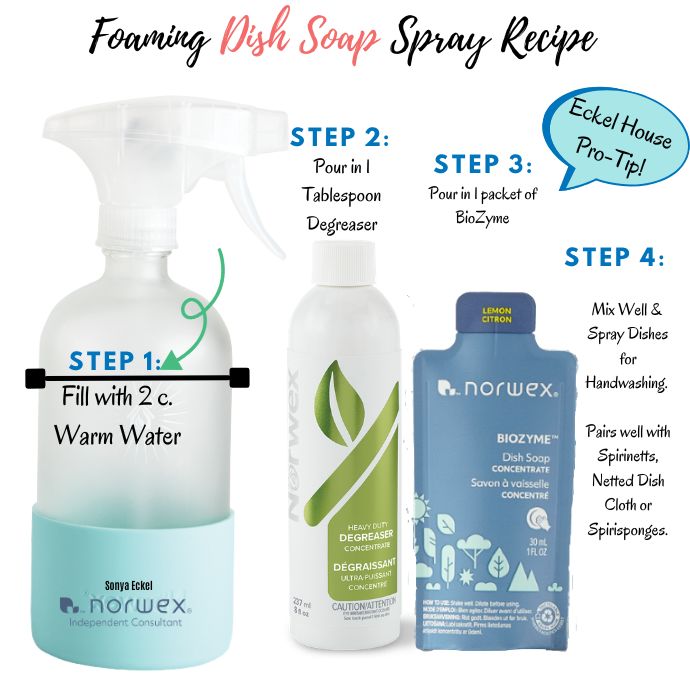
Sonya’s COMPLETE KITCHEN GUIDE: How to Clean Your Kitchen with Norwex
Norwex Scrubber Troubleshooting
Which Norwex scrubber should I use?
Oh, friend.
I made an entire guide for this one because Norwex now has enough scrubby things to create its own small zip code.
The short version:
Spirinett: serious scrubbing power
SpiriSponge: scrubby sponge-style option
Ultra Scrub Cloth: a more aggressive cloth-style scrubber
EnviroSponge: microfiber + scrubby side
EnviroScrub: similar concept in a thinner cloth format
Bamboo Multipurpose Cloth: a little extra scrub while still feeling more like microfiber
The right answer depends on what you’re cleaning.
Which Norwex Scrubber Should I Use? My Complete Comparison
Can Spirinett scratch?
Anything sufficiently abrasive deserves respect.
And this is one place where I can give you more than a label answer: I personally scratched a toilet bowl with a Spirinett years ago.
So yes, I’m cautious with it.
When you’re unsure, start with the gentler tool.
You can always increase scrubbing power.
It’s considerably harder to un-scratch something.
Norwex Bathroom Troubleshooting
Why isn’t my bathroom getting clean with just water and microfiber?
Because “cleaning the bathroom” can mean very different things. Fresh toothpaste on the counter? Everyday grime? Soap scum? Makeup in the sink? Grunge in the tub?
Or are we talking… Hard-water scale? Rust? A toilet ring?
Those are notably different challenges.
Microfiber + water can handle an incredible amount of everyday cleaning, but mineral buildup and established soap scum may need a product designed to break them down.
How to Clean Your Bathroom with Norwex: My Complete Bathroom Cleaning Guide
Why do I still have water spots after cleaning my shower?
If the spots disappear while they’re wet and return when the glass dries, that’s a clue you’re likely dealing with minerals rather than ordinary dirt. That’s when I start thinking about hard water and Descaler rather than scrubbing harder and harder with the same cloth. (See my earlier note on Descaler.)
BacLock® + “Does Norwex Disinfect?” Questions
What exactly does BacLock® do?
This one deserves a clear answer because there has been a LOT of sloppy language online over the years.
BacLock® is the antibacterial/antimicrobial agent in certain Norwex products that is intended to protect and self-clean the product itself by inhibiting bacterial odor, mold and mildew growth within the product.
It does not mean the product protects people from disease-causing pathogens. That distinction matters.
Does Norwex disinfect surfaces?
Cleaning and disinfecting are not identical processes.
Norwex microfiber is primarily about mechanical cleaning—physically picking up and removing material from the surface.
If a situation specifically calls for disinfection, follow appropriate disinfection guidance for that situation rather than assuming BacLock® in a cloth turns the cloth into a surface disinfectant. It does not.
Disinfecting, by definition, is a chemical process. So a mechanical cleaning alternative like Norwex, can not by definition, disinfect. However, the cloths have been tested to REMOVE up to 99% of bacteria from the surface when following proper care and use. But it’s a completely different mechanism from chemical cleaning.
Can I clean up after raw chicken with Norwex?
For ordinary surface cleaning, microfiber can physically remove material from a surface. For me personally? I do trust the microfiber to remove the raw meat juice (again, mechanical action). I have used high-quality, professional swabs testing for the presence of protein hundreds, if not thousands, of times and each time the test comes back free from protein left behind on the surface. So for me and our family, I do trust the cloth. But most often, if it was a cutting board, I spray the Biozyme dish soap or run it through the dishwasher anyway.
However, food-safety situations deserve appropriate food-safety practices. If a surface requires sanitizing or disinfecting after contact with raw meat, follow the applicable food-safety instructions for that surface. So my official answer on this one will be to follow food safety guidelines from experts. 🙂
Can I Use Norwex on Different Surfaces?
One thing I want you to remember throughout this guide is that “Norwex” isn’t one thing.
A microfiber cloth, Cleaning Paste, Descaler and a Spirinett are very different cleaning tools.
Norwex has intentionally created various products to serve best for varied surfaces. For instance, the Descaler is not considered safe on natural stone, but the Multipurpose Everyday Cleaner (Hard Surface Enzyme and Probiotic Cleaner) is considered safe on natural stone. So choose the correct product for the job.
Can I use an EnviroCloth on granite?
For everyday cleaning of washable surfaces, microfiber can be useful, but always consider the particular stone, sealant and finish. From my personal experience, I have LOVED a Norwex EnviroCloth or Kitchen Cloth with JUST WATER on our quartz countertops, marble countertops, and our current granite!! It’s been amazing. And if it’s black or shows streaks, just wipe behind it with a window cloth (like on the black granite we currently have at our ranch).
And don’t assume that because the cloth is appropriate, every Norwex cleaner is appropriate.
For example, Cleaning Paste may scratch granite and Descaler should not be used on natural stone.
Surface + product + cleaning tool all matter.
Can I use Norwex microfiber on stainless steel?
Generally, yes, but I would test first on easily scratched surfaces such as brushed stainless steel. For shiny stainless, I usually clean first and then polish. Norwex does also have a Stainless Steel Cloth specifically for that job. I tend to just use the EnviroCloth and Window Cloth on ours though.
Can I use Norwex microfiber on screens?
Be careful. Different televisions, laptops, phones and monitors can have different coatings, including anti-glare coatings.
Don’t assume that every screen should be cleaned exactly the same way just because you’re using microfiber. Follow the manufacturer’s care instructions for the device.
Our most screen-safe cloth currently would be the Norwex Optic Scarf (and my customers RAVE about it for cell phones, laptop screens, iPads, glasses, sunglasses, the touch screen in their car, etc… and it’s made to clip on something to always have it handy. People often come back to buy MULTIPLES of these once they’ve tried their first one. They always are shocked that it can clean SO MUCH better than other optic cloths they’ve tried in the past. Worth giving a try, for sure!
General Norwex FAQs
Do I really only need water with Norwex?
For many everyday cleaning jobs, water + microfiber is exactly where I start. But “Norwex works with water” does not mean “water solves every cleaning problem known to mankind.”
Grease, enzymes, hard-water minerals, soap scum, laundry stains and baked-on food are different challenges.
That’s why Norwex makes specialty products too. If you’re brand new and trying to understand this whole concept, start with my Norwex beginner’s guide: New to Norwex? Start Here.
Do I have to use Norwex detergent to wash Norwex cloths?
The most important thing is protecting the microfiber from products that coat or damage it.
Current Norwex care guidance recommends its laundry detergent and specifically says to avoid bleach, fabric softener and dryer sheets with microfiber. If you’re using something else, ingredients, artificial fragrances, fillers, and residue matter.
My honest opinion? Can you find another detergent that is OK? Sure. Is it worth giving the Norwex Powerzyme a try because it just may become your favorite laundry soap ever… um yes. I think so. 🙂
How often should I wash my Norwex cloths?
There isn’t one magical number that applies to every cloth and every job.
A Window Cloth used to polish a mirror is not living the same life as a Kitchen Cloth that just met spaghetti sauce and wiped grease off the stove. Slightly dirty microfiber can often be thoroughly rinsed and reused before laundering, while heavily used microfiber should be properly laundered.
My rule is simple: Pay attention to what you cleaned. I did this Norwex cloth care video to answer questions like this- you might find it helpful. 🙂
Do I have to rinse my Norwex cloth after every use?
I recommend that you do. It’s pretty quick and I think you’ll be so much happier long term. Just a quick rinse, friction the fibers against themselves under running water, wring out, and hang to dry or keep cleaning.
There’s something called a PAR rinse. Press the cloth against itself under running water, agitate the fibers against themselves, rinse, and then wring it out and hang it open to dry.
Don’t wad your wet microfiber into a little ball beside the sink for three days and then blame Norwex when it smells like a middle-school locker room. ?
How long do Norwex cloths last?
Instead of deciding based purely on age, I pay attention to performance.
Is it still:
- picking up debris?
- absorbing properly?
- cleaning effectively?
- rinsing clean?
- structurally intact?
A cloth that has been used and cared for properly can serve you for a long time. Norwex recommends replacing the cloths every 2 years (which is their warranty period on their microfiber cloths and mop products). I have personally found mine to last much longer, but I often retire my older cloths to the garage, the car, etc.
When should I replace my Norwex microfiber?
Again, Norwex suggests every 2 years. And if you’re like me and just love a clean, beautiful new cloth set from time to time, two years is a nice recommendation. With that said, I’ve had many of mine over a decade and they’re still going strong.
But the official recommendation is every 2 years. 🙂
Is Norwex worth the money?
That depends on what you’re comparing and how you’re going to use it.
If you buy expensive microfiber and then never learn how to use it, wash it incorrectly and leave half of it sitting in a drawer… probably not.
But if the products replace disposable products and multiple cleaners in your home and you actually use them for years, that’s a very different calculation. Norwex has saved us, at the Eckel house, THOUSANDS of dollars in no longer buying the cleaners we used to buy. Paper towels, cleaning wipes, glass cleaner, all-purpose cleaner, shower cleaner, granite cleaner, stovetop cleaner, floor cleaner, wood polish. I bought them all. I bought those disposable floor cleaning thingies. Yes, Norwex has saved us SOOOO much money.
A fun little exercise is to go to a store website and start adding in the paper towels, cleaners, disposable cleaners that you have purchased in the past. I’m always shocked at how fast it counts up… and most all of those, we no longer purchase.
Still Having a Norwex Problem?
If you made it all the way down here and I haven’t answered your question, I actually want to know about it.
After 17+ years with Norwex, I’ve answered a LOT of unusual questions—but you guys continue to surprise me.
New to Norwex?
If you landed here because Google sent you down a rabbit hole after searching something like “Why does my Norwex cloth stink?”—welcome. You don’t need to understand every Norwex product at once.
I’ve created a simple roadmap to help you understand what Norwex is, how the microfiber works, which products I recommend starting with and where to find my best tutorials and reviews.

Leave a Reply
You must be logged in to post a comment.